Here’s a glimpse into the lessons, stories, and tools that have inspired thousands of readers to reflect, reframe, and rise above challenges.
Buy Now
Here’s a glimpse into the lessons, stories, and tools that have inspired thousands of readers to reflect, reframe, and rise above challenges.
Buy NowCurious about the book?

Here’s a glimpse into the lessons, stories, and tools that have inspired thousands of readers to reflect, reframe, and rise above challenges.
A simple yet powerful framework used by Ismail Gafoor to make tough calls with clarity. Balancing Principles, People, and Performance, this tool is introduced throughout the book’s 25 chapters — guiding readers to think differently about leadership and life.
A simple yet powerful framework used by Ismail Gafoor to make tough calls with clarity. Balancing Principles, People, and Performance, this tool is introduced throughout the book’s 25 chapters — guiding readers to think differently about leadership and life.
 Preview
Start reading now!
 Preview
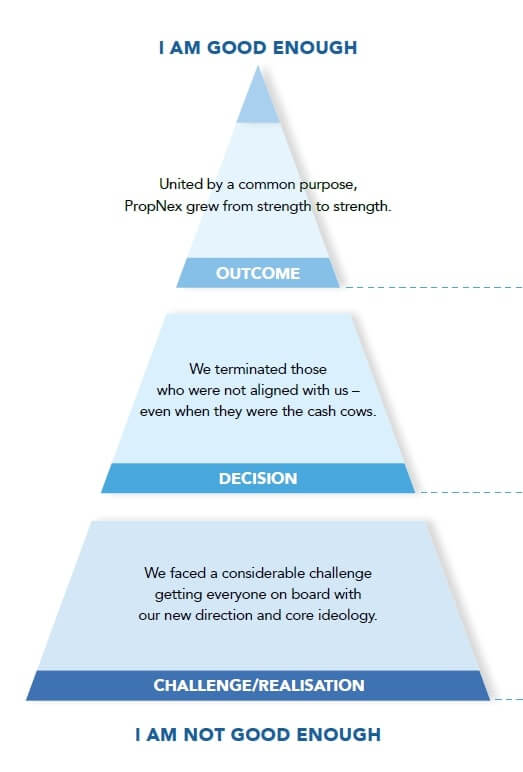
Within four years after the full merger to form PropNex, we terminated two of the leaders of our biggest teams and 2,800 agents. These occurred in three separate incidents, with the earliest a mere six months into our new setup. As draconian as it sounds, believe me when I say that each time, we were left with no choice. By then, I had abandoned my fixation with being the largest real estate agency in Singapore.
Instead, what guided us were our core values. In a way, it made running the business much easier on the manpower front. Anyone who was not aligned with them would be shown the door. We abbreviated our core values as CARE1, with a heavy emphasis on the E, representing “ethics, honesty and integrity”. Often, companies and their employees pay little heed to these things but to us, they were our guiding lights – and continue to be so right up till today.
The first shake-up took place on 22 June 2004. It stands out clearly in my memory because the termination was of the leader of our largest team then, with more than 1,000 salespersons under his wing. Combined, they generated about 20 percent of PropNex’s revenue. Was it a foolish move? If we were solely preoccupied with making money, it would have seemed that way. However, we were not. Our priority was to build a business founded on good ethics, honesty and integrity and nothing could make us deviate from this.
What stood out about this incident was that we were completely blindsided by it. The leader – we shall call him Leader A – was the picture of amiability and a team player through and through. Right up to the moment we found out about his unacceptable behaviour, he continued to join us for lunches and participate in company events without displaying any hints of unhappiness. Therefore, when we learnt about his true intentions, it was a bitter pill to swallow.
It all started with our decision to move from Novena Square to a larger office within the new HDB headquarters in Toa Payoh. The nature of our business means that it is necessary to be situated as close to HDB as possible, for the convenience of our clients, many of whom are purchasing public housing units. We were considering taking up two floors, totalling 25,000sqft, to be able to accommodate our growth plans and house all our agents. This was more than two times larger than our original space, which then stood at 10,000sqft.
Given the size of the commitment, it was important to seek buy-in from the teams before we moved forward. This was also our way of assessing if everyone was on board with us for our next stage of development. We felt that since we had laid a strong foundation, it was time to level up, including with our office space. An internal survey signalled to us that many of our agents were interested and, therefore, we signed the lease with HDB.
At the start of June that year, we invited all the team and division leaders, numbering more than 100, for lunch at Holiday Inn Hotel at Cuppage Road and laid out our plans. We shared that since we now had this sizable office, we would have a balloting system for them to select their rooms to ensure the process was fair and transparent. Given how some were better than others, with windows and good views, we thought this was the best way to allocate space. Leader A attended too, appearing happy and agreeable throughout the entire discussion.
When the ballot results came in, we realised that the demand was not as strong as the survey results had shown. We became worried. A three-year rental agreement for two floors in the building, HDB Hub, had already been inked and there was no turning back. Further analysis revealed that there
were a significant number of division leaders from Leader A’s group who did not participate. Puzzled, we decided to dig a bit deeper to find out what was going on.
It did not take long for us to learn that he was sabotaging our growth and stability. He had been telling his division leaders not to ballot for an office space as he was making plans to leave and was inciting them to go along with him. This came on the back of him being disgruntled over a shareholding matter that we were in talks with him about. It was a very sobering moment for me when I realised how much of an expert in hypocrisy the leader of our largest team was.
Till today, I wonder if Leader A was setting himself up to be terminated. His behaviour clearly violated the terms of the agreement he had signed when he joined PropNex, which included no poaching and that he would always act in the best interests of the company. To me, what was more glaring was how this showed the lack of trust between Leader A and the rest of the management – something that I feel is the cornerstone of any relationship, without which it cannot move forward smoothly. All this proved that he was not aligned with our core values and, therefore, warranted termination.
A few hundred salespeople left with Leader A. Among those who stayed was an enterprising younger division leader, whom I shall call Leader B. He reached out to me on the same day of the termination announcement and offered to lead the salespeople who were under Leader A but did not leave with him. Given the disarray that we were in then, I recognised the need for a smooth, quick transition and agreed to Leader B’s proposal.
Overnight, he inherited what was still a fairly large team. Because of his ambition and drive, Leader B soon recruited more and, very quickly, became the biggest team in PropNex with more than 1,000 agents. He did not just stop at transacting real estate though. In the next three years, Leader B went on to establish multiple other companies, such as car rental, automotive grooming, credit solutions, property development and IT solutions.
He made many of his division leaders shareholders of all these companies and, in doing so, created a very complicated web. On many occasions, we also noticed how he would print flyers and name cards where his parent company logo was much larger than PropNex’s. By then, we had already corporatised and had brand guidelines that had to be adhered to. Naturally, we could not allow this to go on.
I remember having multiple one-on-one breakfast meetings with him, telling him that what he did was not right. As the leader of the largest team, he was a role model to others and had to toe the line by setting a good example. His behaviour, I told him, was sending all the wrong signals to the other team leaders. Unfortunately, whatever I said fell on deaf ears; Leader B had one excuse after another for everything he did, none of which justified his actions.
In the army, there is a phrase called “Beyond Economical Repair” or BER for short. It mostly applies to anything logistics-related, such as transport vehicles, and means that the cost of repair exceeds the item’s worth by more than 75 percent. To me, Leader B fit right into this category and we decided to do something. I called for a meeting with the founding partners and together, we agreed to terminate him, again on the basis of the non-alignment of values.
In true military fashion, I codenamed it Exercise Orion, and drew up a plan to make the process swift and decisive. Only a select few in the management team were aware of it – everything was on a need-to-know basis only. We set up a secret war room and hired part-timers to fold and seal letters for Leader B’s more than 1,000 agents. After checking with SingPost, we timed it so that we mailed them out on a Saturday, in order that they be received by 5pm the following Monday. In it, we explained our decision to terminate Leader B and invited them to join me for a briefing at HDB Hub’s auditorium on Wednesday.
On Monday morning, 24 September 2007, I instructed Leader B to come to my office for yet another one-on-one meeting – but this time, it was going to be the last one.
When he came in and sat down, I started by talking about how this was not our first conversation about the misalignment of values. I then went on to say that for both our sakes, we should part ways.
Leader B was completely stunned and speechless for a few seconds, before he regained his composure and tried to protest. However, we had made our decision to terminate him and there was nothing he could say to change our mind. Additionally, there was the matter of how the letters were already mailed to his agents. Realising he had been backed into a corner, he accepted his fate and left. I soon learnt that he took a few hundred of his agents with him and joined HSR, which welcomed them with open arms – but more on this later.
The third round of termination occurred less than a year after we let Leader B go, on 1 August 2008. With 2,800 agents in this tranche, it was also the largest number. The circumstances though, were quite different from the first two times, even as the underlying reason continued to be the same: non- alignment of core values. With this “last clean up”, as I called it in my head, it clearly sent a message to the industry to say that we were interested in quality over quantity.
This incident had its roots in the unregulated nature of the real estate industry. I labelled it the “wild wild west”, where numerous stories about consumers being taken for a ride by unscrupulous agents abounded. While it was necessary for real estate agencies to have a licence, which itself came with a set of strict criteria, any Tom, Dick and Harry could be a real estate agent, as long as they were registered under an agency. With practically zero barriers of entry, the industry
saw its fair share of part-timers, moonlighters and those out to make a quick buck
In fact, I remember as far back as in 2000, some agents were facilitating loan sharks to illegally lend up to $150,000 to unsuspecting, vulnerable homeowners at exorbitant interest rates. Determined to protect the image of the industry,
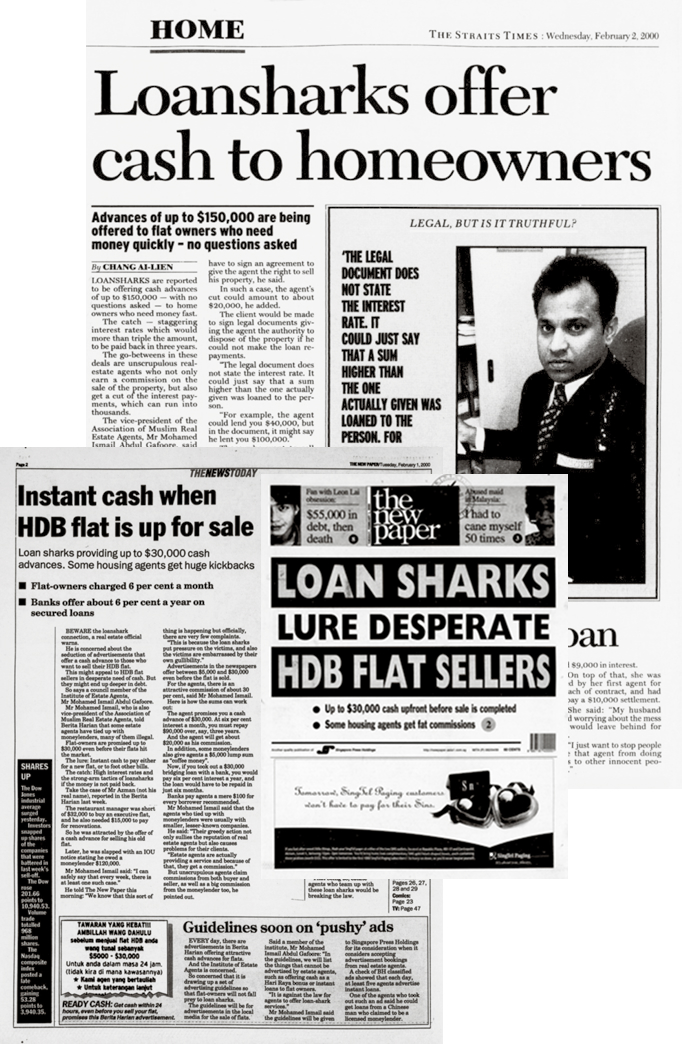
After I blew the whistle on unscrupulous agents, the media covered the news extensively.
, I exposed this to the media and The New Paper ran a story on its front page in February that year. After the news broke, I received at least three different phone calls from rough-sounding men harassing and warning me to stay out of their business. I went on to make a police report and, fortunately, nothing happened to me but those were certainly hairy times.
A negative consequence of all this was how real estate agents were not looked upon favourably. They had no professional standing and were often treated with suspicion. You can imagine how much it bothered me. A PropNex agent was certainly none of the above. We anchored our business on trustworthy service but even then, all it took was one or two bad apples, who did things out of self-interest, to destroy that image. When we learnt of them, we immediately terminated and went public with their names to make examples out of them.
Additionally, PropNex would buy a company-level insurance policy that protected it for up to $5 million. This, we felt, would offer a double-barrel type of protection for the consumers, giving them the peace of mind that they sought. I personally made a pitch to the insurance provider to show them that we were a legitimate company with a sound structure, strong training programmes and proper compliance processes in place for our agents. In doing so, I managed to secure a good deal, where every agent only had to pay $100 plus the prevailing GST, which was then seven percent.
This incident had its roots in the unregulated nature of the real estate industry. I labelled it the “wild wild west”, where numerous stories about consumers being taken for a ride by unscrupulous agents abounded. While it was necessary for real estate agencies to have a licence, which itself came with a set of strict criteria, any Tom, Dick and Harry could be a real estate agent, as long as they were registered under an agency. With practically zero barriers of entry, the industry
saw its fair share of part-timers, moonlighters and those out to make a quick buck
In fact, I remember as far back as in 2000, some agents were facilitating loan sharks to illegally lend up to $150,000 to unsuspecting, vulnerable homeowners at exorbitant interest rates. Determined to protect the image of the industry,
We made the announcement at an internal town hall meeting. There, we encouraged the agents to buy the policy and explained our rationale behind it of championing agent professionalism and consumer protection. We told everyone that we had set a deadline for them to purchase the policy by 1 August 2008 and if they did not, we would terminate them.
In the first few weeks, the sign-up rates were slow, with less then 50 percent buying in to the idea. Undeterred and sure that we were doing the right thing, I gathered the founding partners and together, we each contacted the various team leaders and personally spoke to them about this.
I remember in one of the discussions, a top-producing agent came into my room to challenge me on my decision. “I’ve been in the business for more than 10 years and I am not a crooked agent. Why do I now need to go and tell my customers that I have this insurance policy? It makes me look like I was a crooked agent before,” he fumed. “I don’t think you should make this compulsory. You are making me feel like I’m not a good agent. If you value me, you can pay the $107 and I will stay on.”
As a matter of principle, I could not pay for him. I certainly had the means to, but it would open the floodgates to a whole host of other problems. I tried to explain our thinking
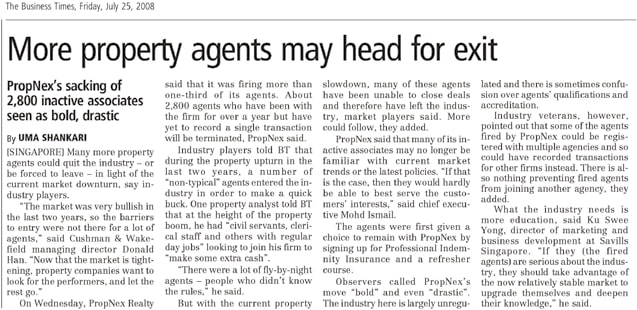
The media picked up the story on our terminating 2,800 agents.
behind the entire exercise again but, despite my best efforts, he decided to leave us. There were many others like him, 2,800 to be precise. On 1 August, we sent out an email to those who did not sign up for the policy and terminated them.
Overnight, we lost our position as the largest agency in Singapore but we were not bothered by it. What mattered more was that after the shake-up, we brought an unprecedented level of professionalism to our salespeople. A mere two years later, in 2010, the Council of Estate Agents was formed to regulate the industry.
Among the many requirements it laid out was that all agents had to be covered by a professional indemnity insurance policy. Say what you like but we were obviously ahead of our time – this is what happens when you set your sights beyond just driving the bottom-line and are interested in the greater good.
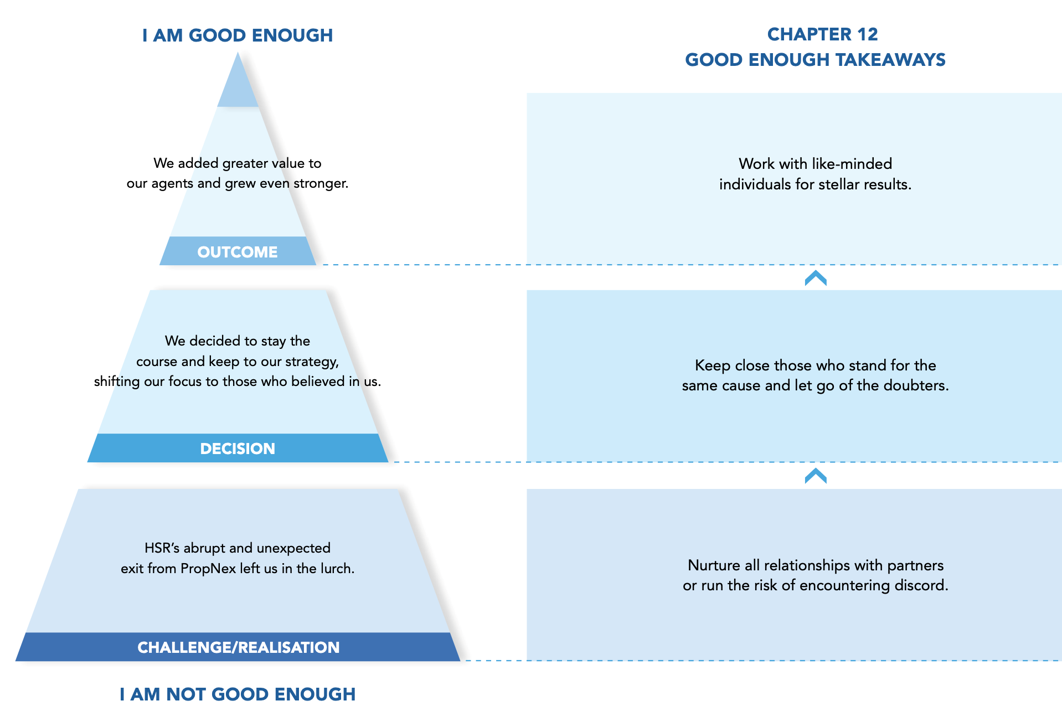
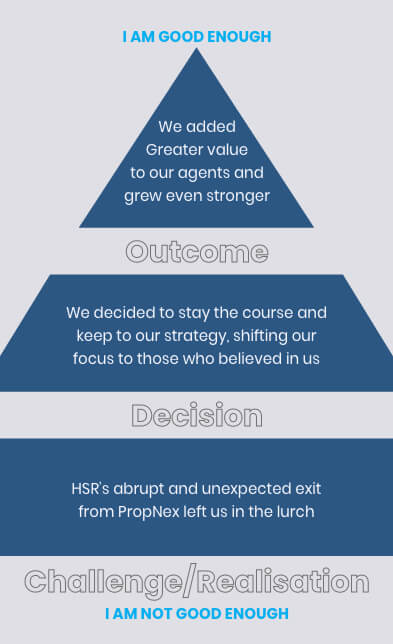
In the middle of all this internal drama, we had a small run- in with HSR. In June 2007, it started to claim that it was the largest real estate agency in Singapore in its advertisements and marketing material. It went so far as to get itself listed in the Singapore Book of Records (SBOR) with 5,136 agents.
When we found out, we realised we could not let this pass. Earlier in the year, in April, we had submitted to the Inland Revenue Authority of Singapore that we had 6,186 active agents working with us. This far eclipsed HSR’s claim just two months later, making it inaccurate and affecting PropNex’s business standing. It had the potential of causing confusion among consumers and damaging our credibility in the market.
We immediately sent a legal letter to the SBOR, pointing out the misrepresentation and asking for a rectification. The media even got wind of this and The Straits Times ran a story on the “tussle”. It reported that HSR was “told not to attribute the claim of being the largest agency to the SBOR in its ads”. Very quickly, HSR stopped using this tagline altogether.
I choose to bring this incident up because my message is simple. As a leader, it is my responsibility to defend my business and the people who work with me. If I know a wrong has been done to us, and it will hurt us, I will not allow it to pass. It brings me no joy to involve lawyers but when our rightful position is questioned, I will stop at nothing to protect it.
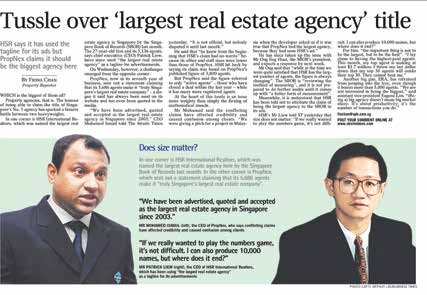
The Straits Times article about the “tussle” between PropNex and HSR